
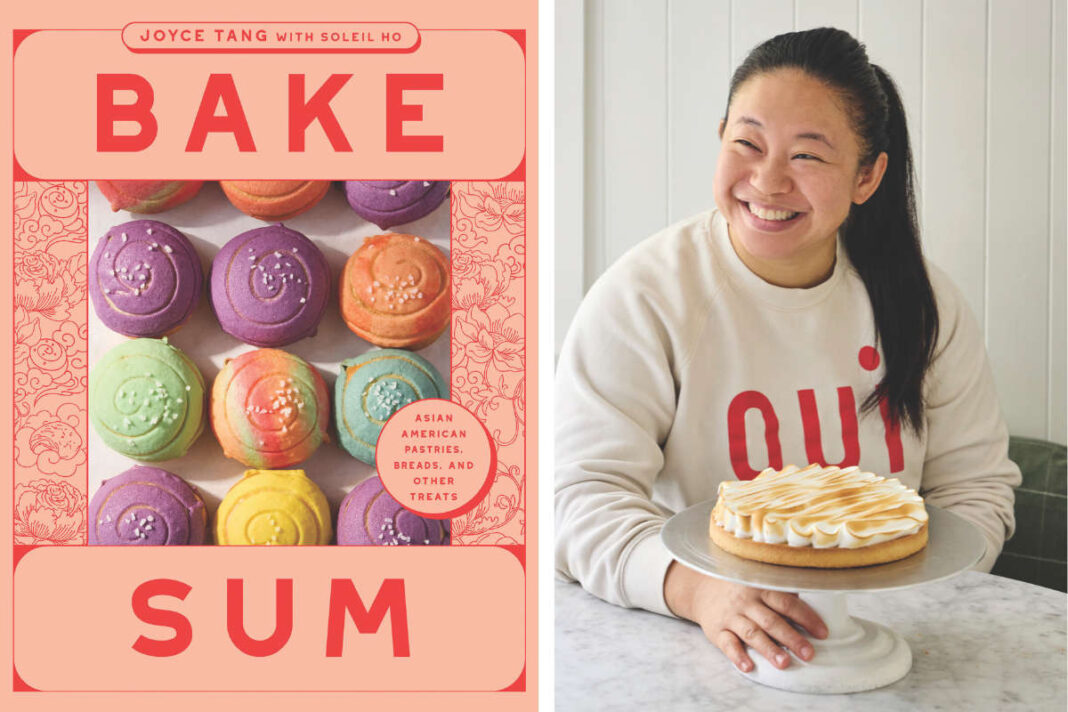
In 2021, Joyce Tang started Bake Sum at the Bread Project’s commissary kitchen. Five years later the bakery moved into a second location in Alameda. Since those first pastry box pop-ups in Berkeley, Bake Sum has expanded its repertoire. There are more cakes, cookies, milk buns and mochis, and more flavors.
“We’re playing with tofu puddings and mango sticky rice,” Tang told me during a phone interview. “We’re constantly trying to add things that help with dietary restrictions.”
Bake Sum’s team, which has grown from five to 20, is always floating new ideas, more than they have the time or energy to execute. “We were carving out some time on Tuesdays for more experimentation and to launch some test bakes,” Tang said. “While that’s been fun, with our challenge of the new store we’re having less and less time for that again now.”
The Grand Avenue location was never large enough to keep up with the amount of pastries they sold. But after five years in the commissary kitchen, Tang felt Bake Sum needed its own space. Moving to Alameda—formerly Feel Good Bakery’s space—seemed like a natural evolution. There’s more equipment there and more drawers to freeze ingredients.
“Because we’re in a shared market, we don’t need to dedicate as much space to seating or to the front-of-house,” Tang said. Even so, at this early stage, the crew struggles to keep up with production. “No matter how much we make, it just doesn’t feel like enough,” she continued. “And we’re making almost one and a half times what we were making a couple of months ago.”
The Oakland team is more tenured than the Alameda team. But Tang and Ari Daoheuang, who’s worked at Bake Sum from the start, train and help everyone get up to speed. Tang said that while the Alameda staff has worked in production for many years, the retail element is new to them. And, along with the roster of pastries, they also make an ambitious beverage menu, which features matcha tea, espresso tonics and a pandan cold brew.
Tang’s previous experiences as an employee inform her approach to running a business. “I have worked in a lot of kitchens where the pace of life felt quite unsustainable,” she said. “And we have a lot of mothers on the team, new moms. Ari had their baby last year.”
The goal is “not to make the most money or the most pastry possible,” Tang said. Rather, it’s to operate a business “where the lifestyle is sustainable for me and my team.” If someone doesn’t get a pastry at the end of the day, she said, the world will not end. “We’ll make more pastries tomorrow.”
Despite the long customer lines and the expansion into a second store, Tang’s perfectionism resists the idea that Bake Sum is an unqualified success. “It doesn’t always feel that way,” she said. “It’s easy to fixate on things that we need to improve every single day.” Bad reviews, no matter how minor, linger for a long time. “There are constantly challenges outside of what is all shiny and glossy from what you see on Instagram,” Tang added.
The Bake Sum team reads all the reviews, but responding to them is another matter. One nasty review complained that the bakery closed on a Saturday for an hour lunch break. “We shut the door and he didn’t get inside, and he felt a little salty about that,” Tang said. But the Grand Avenue store is small, and it’s not possible for the staff to take a “normal” break.
After trying out a few different options, taking a collective lunch midday worked better than anything else. “I know it’s unconventional to do this, but it was legitimately the only way our team would get to rest and not sacrifice service levels,” Tang said. Unlike Europeans, who take humane lunch hours, many Americans don’t understand why a business would put people before profit.
This fall will see the release of Tang’s first cookbook, co-authored by Soleil Ho. Bake Sum: Asian American Pastry, Breads and Other Treats, she said, “tells a really fun and collective story about what Asian American pastry looks like in the Bay Area.”
The book is organized in the same way Bake Sum typically trains its team members. “I start out with drinks and puddings and jellies so that it’s more approachable,” Tang said. “Then we go into cookies, cakes, bread, milk bread—and then we go into croissants.” The croissant recipe is a simplified version for home bakers. “I hope it will encourage more folks to try lamination at home,” she added.
This summer, Bake Sum is making mango milk buns and strawberry sandwiches on croissants, essentially a strawberry cream sando. “We’re trying to go a little more fruit-forward to capture some of the seasonality that we have in the Bay Area,” Tang said. “But, you know, it does come down to how much time it takes us to chop all that fruit.”
Bake Sum, 3249 Grand Ave., Oakland, and 1650 Park St., Alameda. bakesum.com. Check Instagram for hours: @bakesumpastries.